
How do we support children to become fluent mathematicians at Pye Bank?
Mastering Number
Pye Bank takes part in the National Centre for Excellence in the Teaching of Mathematics (NCETM) Mastering Number programme. This is implemented in the Early Years Foundation Stage and Key Stage 1 to develop a strong and secure understanding of number sense.
Through the programme, children engage in daily opportunities to revisit and embed key mathematical skills. Learning is carefully sequenced into small, manageable steps, ensuring that pupils are secure in each concept before moving on.
Mastering Number supports children in developing fluency in calculation by the end of Key Stage 1. It builds their confidence and enables them to work flexibly with numbers, laying the foundations for success in mathematics as they progress through the school.
Fluency Friday
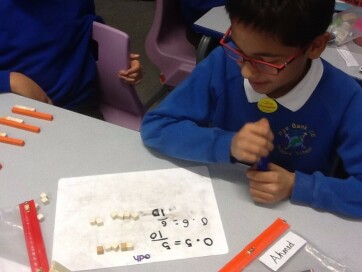
Each Friday session is dedicated to developing fluency. These sessions give children opportunities to engage with a wider range of mathematical content beyond the current unit of learning.
The focus moves from instant recall and number facts in Key Stage 1 to efficient and accurate calculation methods across a broad range of arithmetic skills in Key Stage 2.
 During these sessions:
- Children complete arithmetic tests and identify areas where they feel less secure
- Teachers review answers, highlighting misconceptions and areas for development
- Identified gaps inform retrieval practice and the focus for the following week
- Teachers model effective strategies and methods
- Pupils practise collaboratively, with targeted teacher support and intervention.
This cyclical approach ensures gaps are addressed quickly, building confidence, fluency and accuracy over time.
Claire Christie Approach to Times Tables (KS2)
In Key Stage 2, we have a daily focus on times tables using the Claire Christie approach. This is based on the 36 key multiplication facts identified in national guidance.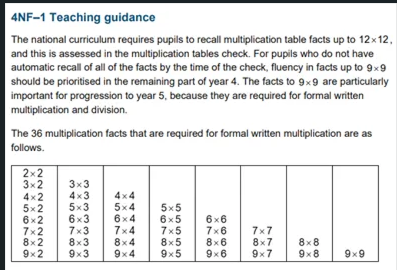
Our approach includes:
- A systematic, whole-class approach to learning times tables
- Breaking learning into manageable steps, focusing on one table at a time
- Emphasising the commutative law and links between multiplication and division
- Rote learning of number facts alongside rhythm and pattern
- Frequent, short practice, including two-minute tests with 40 questions
This structured method builds fluency, accuracy and confidence. We also use Times Tables Rock Stars to support children in learning their multiplication facts to automaticity.
Essential Skills
In Year 6, we use Essential Skills sessions to ensure all pupils are secure in key arithmetic concepts. These sessions are carefully informed by ongoing assessment, including weekly arithmetic papers, which help to identify any gaps in understanding.
Teaching is then adapted to focus on these areas, with clear modelling and opportunities for guided and independent practice. MathsBot is used to further support fluency and provide additional practice tailored to pupils’ needs.
This responsive approach ensures that gaps are addressed quickly, enabling pupils to develop confidence, accuracy and efficiency in their calculations, and supporting them to keep pace with their learning.
KIRFS (Key Instant Recall Facts)

KIRFs support the development of mental fluency, which underpins success across the mathematics curriculum. They are particularly important for efficient calculation, including addition, subtraction, multiplication and division.
Each year group focuses on up to six key facts across the year, in line with National Curriculum expectations. These are practised regularly, including during Fluency Friday, to support quick and accurate recall.
Secure knowledge of these key facts allows children to approach more complex calculations with confidence and efficiency. Frequent, short bursts of practice help embed this learning, enabling pupils to apply their knowledge fluently as they move towards more formal and abstract methods.
For this terms KIRFs please click here
Targeted Support
We provide a Ready to Progress group to support pupils who may need additional guidance, ensuring that every child receives the teaching and support they need to keep up and succeed within the mathematics curriculum.
Using the Ready-to-Progress (RtP) criteria, we clearly identify the essential building blocks that children need in order to access the wider curriculum. Through ongoing assessment, we carefully identify any gaps in understanding and provide targeted support to address these.
By focusing on these important stepping stones, we address gaps early, build confidence and ensure that every learner can thrive in mathematics. As a result, pupils develop confidence, resilience and independence in their mathematical learning, while feeling fully included as part of their class community.
Teachers and teaching assistants circulate throughout lessons, providing immediate verbal feedback to support, challenge and extend pupils’ thinking. This approach encourages active participation, promotes pupil talk and ensures rapid progress.
Where needed, rapid intervention is provided either during the lesson or later in the day. These targeted sessions offer additional support to help pupils secure understanding quickly, enabling them to keep pace with the class and continue learning alongside their peers.