
Maths
~LEARNING TOGETHER: LEARNING TO BE TOGETHER ~
At Pye Bank Primary School, the curriculum supports and develops the pupils’ ambitions and aspirations and understanding of the community and the wider world in which they live. The curriculum is underpinned by enquiry based practice and is research led. Through our curriculum we aim to expose children to new experiences, including business and the world of work and research. Academic performance and the development of self (Spirituality, social, moral, physical and cultural development and mental wellbeing) are given equal importance with curriculum design. Our curriculum is designed with the key aim of supporting all children to reach their potential.
Our Intent
At Pye Bank, we want all children to receive an exceptional mathematics education where every pupil develops the knowledge, skills and habits needed to master mathematical concepts. This is achieved through a carefully planned and sequenced curriculum that builds their ability to think mathematically and equips them with skills that will enhance their life chances.
Our curriculum is fully aligned with the National Curriculum. Click here for further information.
Mathematical Proficiency and Teaching for Mastery
The term Mathematical Proficiency captures what it means for pupils to learn mathematics successfully. To support this, we follow the Teaching for Mastery Five Big Ideas, which underpin our approach across the school. These principles ensure all children develop a deep, connected and secure understanding of mathematical concepts.
In our classrooms, this looks like:
Coherence
Learning is broken down into small, connected steps so that children build on prior knowledge 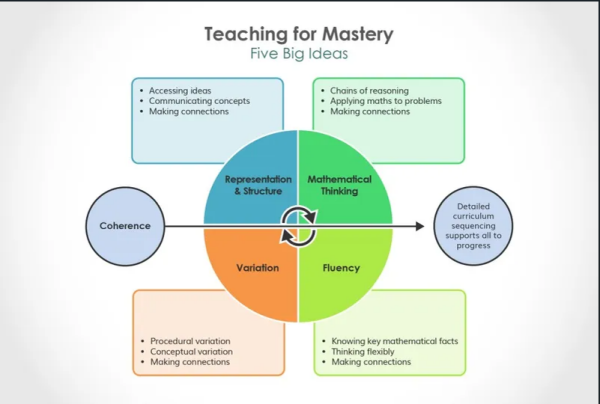 and develop understanding over time.
Representation and Structure
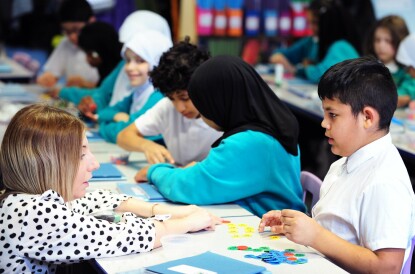
Teachers use concrete resources (such as counters and manipulatives) alongside visual models (such as bar models and place value charts) to support understanding.
Mathematical Thinking
Children are encouraged to explain their reasoning, make connections and justify their ideas using mathematical language.
Fluency
Regular practice supports children in developing quick and accurate recall of key facts, alongside efficient calculation methods.
Variation
Carefully designed examples and questions help children to notice patterns, make connections and deepen their understanding.
Aims of Our Mathematics Curriculum
Fluency
Children develop fluency in the fundamentals of mathematics through varied and frequent practice with increasingly complex problems. This supports a strong conceptual understanding and the ability to recall and apply knowledge rapidly and accurately.
Reasoning
Children reason mathematically by following lines of enquiry, making conjectures, identifying relationships and generalisations, and developing arguments, justifications and proofs using appropriate mathematical language.
Problem Solving
Children apply their mathematics to a wide range of routine and non-routine problems. They learn to break problems into manageable steps and persevere in finding solutions with increasing confidence and sophistication.
Our Curriculum
Our mathematics curriculum is aligned with the National Curriculum and is carefully structured into units to ensure depth and mastery across all areas. At Pye Bank, we follow the White Rose Mathematics scheme from Year 1 to Year 6.
This approach supports all children in working towards age-related expectations, and pupils are not streamed by ability. It provides the time and structure needed for children to develop a deep, secure and transferable understanding of mathematical concepts.
Measurement is woven throughout the mathematics curriculum to provide meaningful contexts for learning, while statistics is explicitly taught in maths lessons and then further reinforced through its application within the science curriculum.
Click here to see how learning is planned across each year group.
Fluency and Retrieval
Pupils have daily opportunities to revisit prior learning and secure fluency in key concepts. These sessions are carefully planned to meet the needs of all learners.
In Years 3, 4 and 5, children take part in daily multiplication practice using the Claire Christie approach
In Year 6, Essential Skills sessions are used to address gaps identified through arithmetic assessments, with MathsBot used to further support arithmetic and fluency development.
We also use the Reflex programme to strengthen pupils’ fluency in a personalised and engaging way. In Key Stage 1, it supports the development of secure number bonds, while in Key Stage 2 it focuses on building confidence and automaticity in multiplication and division facts. The programme adapts to each child’s needs, helping them to practise key skills at the right level. We promote a sense of healthy competition and celebrate progress through regular recognition.
How do we support children to become fluent mathematicians at Pye Bank? Click here to learn more.